Tired of Rote Memorization? Try This Game-Changing Math Fact Strategy Practice
Are your students struggling to recall their addition facts with confidence? Instead of drilling flashcards until you both want to scream, let’s shift to math fact strategy practice that helps kids think, not just memorize.
One of my favorite strategies for building true fluency is the Doubles Plus One method. It’s intuitive, builds on foundational doubles, and makes students feel like math magicians when they finally “get it.”
Let’s walk through four tips to teach Doubles Plus One effectively—plus some fun tools and a freebie to bring the strategy to life in your classroom.
Why Strategy-Based Practice Works Better Than Rote Memorization
Students who only rely on memorization may initially seem fluent… until they hit more complex problems and stall. What they really need is flexible thinking and mental models.
That’s where derived fact strategies—like Doubles Plus One—shine. They encourage students to use what they already know (doubles) to figure out new problems (just add one more!).
By focusing on strategy, you’re equipping students with lifelong tools, not just quick tricks.
What is the Doubles Plus 1 Strategy?
Adding doubles is a mental math strategy that can be used to quickly add numbers. To use this strategy, you take two numbers that are the same and add them together. For example, if you’re adding 5 + 5, you would double 5 to get 10.
Read more about developing strong math fact fluency using mental math strategies.
I’ve got four tips for you to help your little learners master this strategy:
#2: Use the CRA Model + Math Mats to Scaffold Learning
We teach math best when we build understanding step by step. That’s exactly what the CRA Model does:
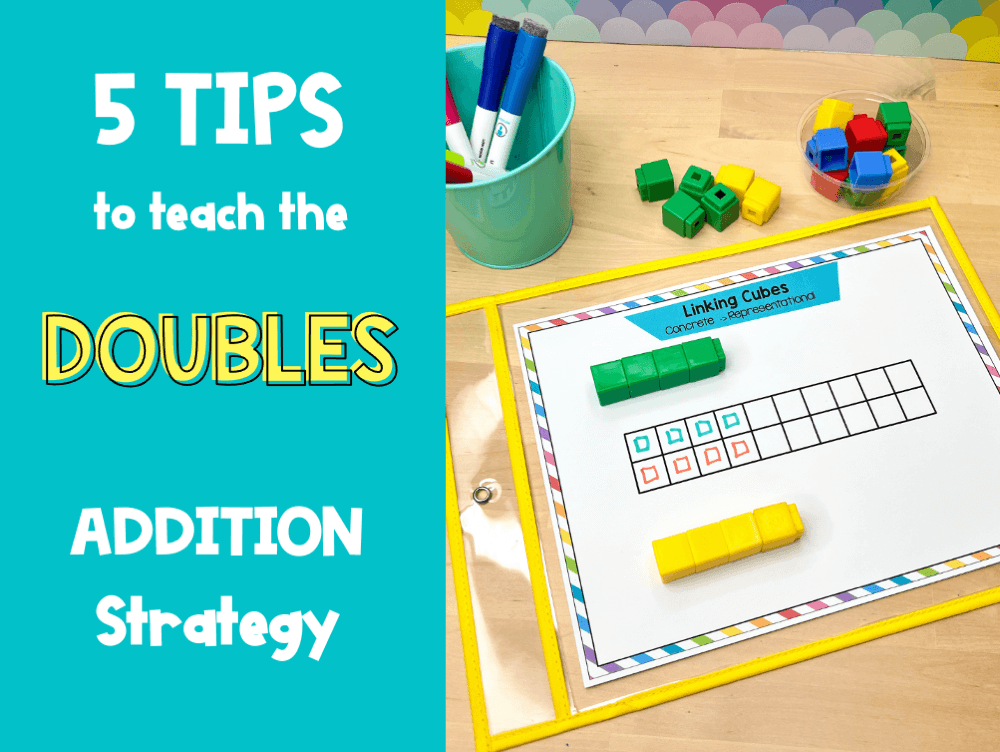
Concrete: Students use manipulatives (cubes, counters, linking bears)
Representational: They draw what they see (dots, tallies, pictures)
Abstract: They write equations using numbers and symbols
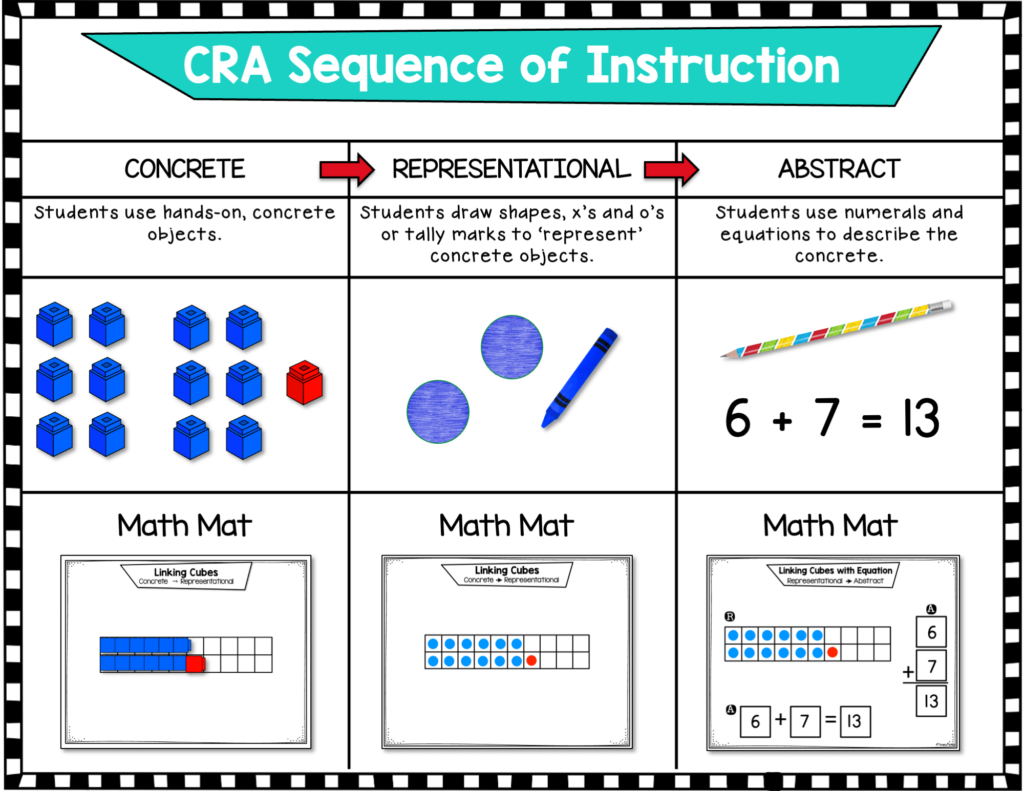
The CRA Sequence of Instruction is an instructional model that leads students through 3 essential phases of learning math concepts: Concrete, Representational, and Abstract.
In the above diagram, we can see the ‘Doubles Plus 1’ strategy progressing through the CRA model with the help of math mats:
CONCRETE: Students use hands-on, concrete objects.
REPRESENTATIONAL: Students draw shapes, x’s, and o’s, or tally marks to ‘represent’ the concrete objects.
ABSTRACT: Students use numerals and equations to describe the concrete.
Let’s take a closer look at using math mats to teach the ‘Doubles Plus 1’ strategy.
CONCRETE:
Give the student many opportunities to practice the concept using a variety of manipulatives. We want to ensure students understand the concept in this Concrete phase before moving to the Representational phase.
REPRESENTATIONAL:
Students use the same math mat as was used in the Concrete phase.
Put it in a dry-erase pocket so the mat can be used with many of the ‘Doubles Plus 1’ facts.
ABSTRACT:
This math mat makes it easy for your students to visualize the math situation and begin using digits and symbols to represent the ‘Doubles’ strategy.
I love using these math mats because they provide the scaffolding that so many of our students need.
#3 Make It Memorable With a Chant + Movements
We all know students remember better when they MOVE. Combine rhythm and repetition with a chant like:
“Double five is ten… plus one makes eleven!”
Add in:
Clapping on doubles
Jumping or arm movements for the “plus one”
Call-and-response style to engage the class
Want a ready-made chant? (Download link below.)
This multi-sensory approach taps into kinesthetic AND auditory learning—so kids aren’t just reciting; they’re experiencing the math.
If you would like this FREE PowerPoint chant for your classroom – find a download link below.
#4 Differentiate Practice with Centers, Games, and Printables
The final key to math fact strategy practice? Repetition with variety. We want kids to see the strategy over and over—but in ways that don’t feel boring.
Now, let’s explore some captivating activities to offer this essential independent practice to your students.
When we shift from drilling to strategic thinking, we’re helping students build a brain toolbox they’ll use all year long—and beyond.
Using the CRA model, movement, chants, and differentiated tools, you can teach Doubles Plus One in a way that sticks. Students will not only remember 5 + 6 = 11… they’ll understand why.
Get started today: Download the FREE Doubles Plus One chant + practice pages, then check out the full product for engaging, no-prep activities your students will actually love.
Cookie Notice
We use cookies on our website to give you the most relevant experience by remembering your preferences and repeat visits. By clicking “Accept”, you consent to the use of ALL the cookies.
This website uses cookies to improve your experience while you navigate through the website. Out of these cookies, the cookies that are categorized as necessary are stored on your browser as they are essential for the working of basic functionalities of the website. We also use third-party cookies that help us analyze and understand how you use this website. These cookies will be stored in your browser only with your consent. You also have the option to opt-out of these cookies. But opting out of some of these cookies may have an effect on your browsing experience.
Necessary cookies are absolutely essential for the website to function properly. This category only includes cookies that ensures basic functionalities and security features of the website. These cookies do not store any personal information.
Any cookies that may not be particularly necessary for the website to function and is used specifically to collect user personal data via analytics, ads, other embedded contents are termed as non-necessary cookies. It is mandatory to procure user consent prior to running these cookies on your website.